

Silent e rules can feel confusing at first, especially when students realize that silent e doesn’t always make the vowel long. If you found this post, I’m guessing you recently discovered that silent e has more than one job, and you want to learn more about the other silent e rules. Let’s dive in!
The Silent e Rule Everyone Knows
Most of us were taught that silent e’s job is to make the preceding vowel say its long sound (its name) in words like cone and made. That is an important job. But here’s the part that surprises many teachers:
That rule only applies about 50% of the time.
When I first learned that, it completely changed how I thought about teaching silent e. If students are taught that silent e always makes the vowel long, confusion is almost guaranteed.

This post contains affiliate links.
So… What Else Does Silent e Do?
According to Denise Eide’s book Uncovering the Logic of English: A Common-Sense Approach to Reading, Spelling, and Literacy, silent e has several distinct jobs in English spelling. When you see them laid out together, English starts to feel a lot more logical.
Here are the many jobs of silent e, with examples and instructional notes.
1. Making the Preceding Vowel Long (About Half the Time)
In roughly 50% of words with a final silent e, the vowel before it represents its long sound.
Examples: cone, made.
This is the job most students learn first. It’s a good starting point, as long as it’s not presented as the only job.
2. Preventing Words from Ending in V or U
English words do not end with v or u, so silent e is added.
Examples: give, true.
This explains why giv isn’t a word, and why the e stays even though it doesn’t change the vowel sound.
3. Softening C and G
Silent e can soften the sounds of c and g.
Examples: cage, face.

4. Giving Every Syllable a Written Vowel
Every syllable must have a written vowel, so sometimes a silent e is added. Think of consonant-le endings.
Examples: bubble, tackle.
That e isn’t silent because it’s useless. It’s there to make the syllable work!
5. Distinguishing Meaning
Silent e can help distinguish between singular and plural nouns.
Examples: moos versus moose
Without the e, how would we know whether we’re talking about an animal or multiple “moo” sounds?
6. Making Words Look Like Real Words
This might sound silly, but sometimes a silent e is added to make a word look bigger.
Examples: awe, owe.
7. Changing the Sound of TH
A silent e can change the /th/ sound from unvoiced to voiced.
Examples: breath becomes breathe, bath becomes bathe.
This is especially helpful for older students who are working on spelling and meaning together.
8. Clarifying Meaning Between Homophones
Silent e can differentiate words that sound the same but have different meanings.
Examples: or versus ore, for versus fore
Again, the e is doing meaningful work, even when it’s silent!
What This Means for Instruction
That’s a lot of responsibility for one little letter! If you’re feeling overwhelmed, here’s the key takeaway:
When you first introduce silent e, let students know that making the vowel long is not its only job.
You do not need to teach every job at once. You do want to plant the idea early that English spelling is logical, but also layered. That single idea can prevent years of confusion later.
Why I Call Silent e a Ninja
I like to think of silent e as a ninja: quiet, sneaky, and powerful. It doesn’t make a sound, but it changes everything around it. That idea is what inspired my Ninja e Phonics Units, where Ninja e sneaks into words and changes sounds in different ways. The units focus on:
Each unit includes a slide deck where Ninja e swoops in to do its job, plus worksheets that support reading and spelling at both the word and sentence level.
The units also include phoneme-grapheme mapping boxes using words from the Dolch and Fry lists, making it easy to align phonics instruction with high-frequency word instruction.

Making Silent e Rules Visible With Ninja e Puppets
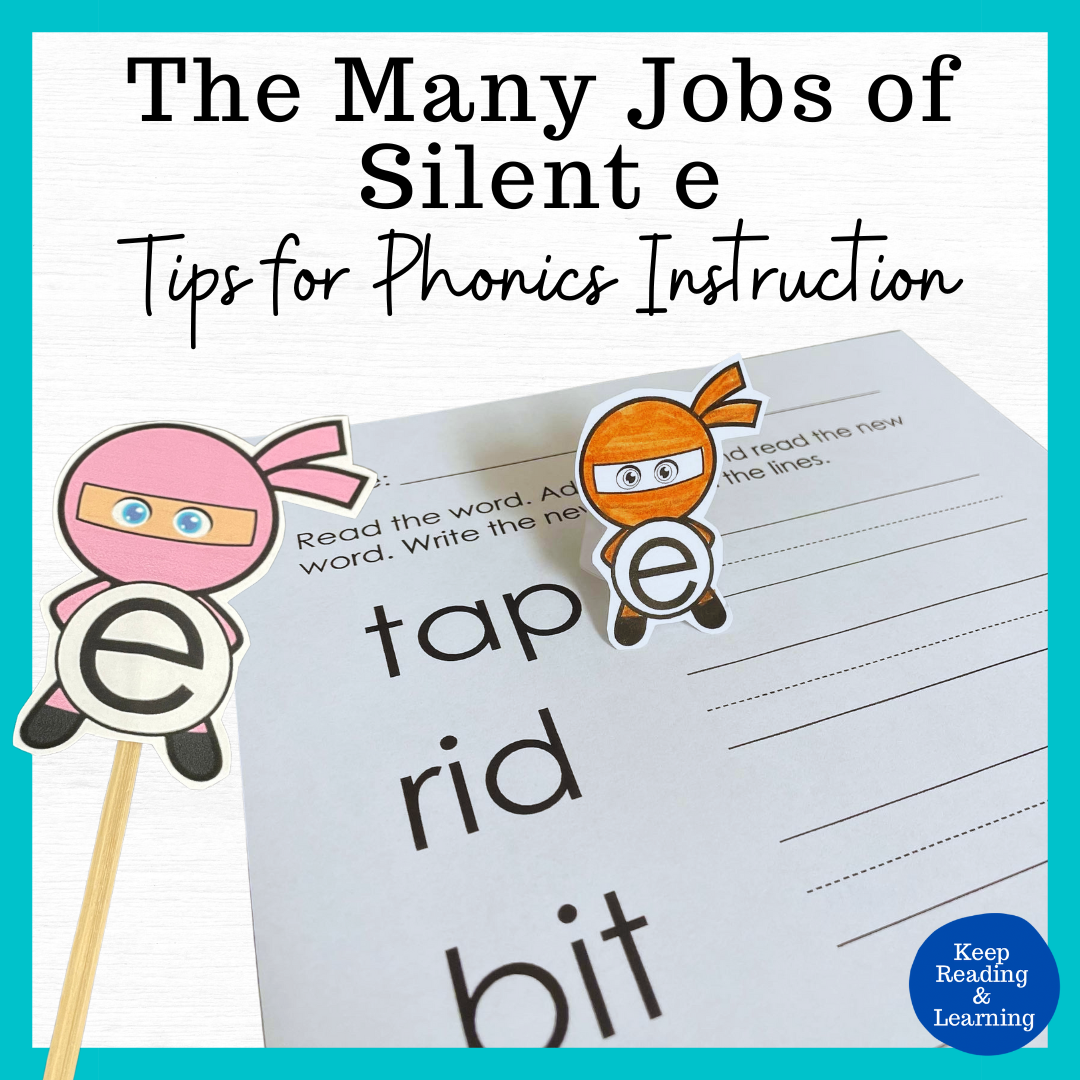
One of the hardest parts of teaching silent e rules is that the letter doesn’t make a sound. So for many students, it feels abstract. That’s why I use little paper silent e ninja puppets!
Students physically place the ninja at the end of a word to show what silent e is doing. For example, they take the word tap, slide the ninja e onto the end, and watch it transform into tape. The ninja doesn’t “say” anything. It just quietly changes the word.

That physical action helps students see the rule instead of trying to memorize it.
The puppets are simple paper cutouts, but they’re surprisingly powerful. Creating a “secret ninja” turns silent e rules into something playful and memorable, especially for students who have struggled with phonics in the past.
One teacher, Andrea, shared this after using the resource:
“I used this resource in my small group reading with struggling readers. They were excited to create their secret ninja and very motivated to find magic e words using their secret ninja.”
That motivation matters. When students are eager to make silent e words, they get far more practice, without it feeling like a drill. Teachers tell me these are some of their students’ favorite lessons of the year, and that’s exactly what we want for a concept that can otherwise feel confusing!
Want to Go Deeper?
If you’d like a deeper dive into the logic behind English spelling, I highly recommend Denise Eide’s book. You may also enjoy these related posts about silent e rules:


Comment
Comments are closed.