

If you’re following the science of reading, you’re likely teaching phonemic awareness and phonics. But are you explicitly teaching morphology? Whether you’re a classroom teacher whose students can decode but struggle with multisyllabic words, an interventionist looking for the next layer of structured literacy, or an administrator strengthening your Tier 1 reading intervention frameworks, morphology instruction for struggling readers has something to offer you. Read on to find out why explicitly teaching prefixes, suffixes, and bases is a game-changer for all readers!
What is morphology?
Morphology is the study of the structure of words and the meaningful parts within them. When I was new to the science of reading, I didn’t realize how interconnected phonics and morphology should be, but in structured literacy, the two go hand in hand. Morphology builds upon phonics by teaching students how prefixes, suffixes, and bases contribute to both pronunciation and meaning, and as Louisa Moats explains in Speech to Print: Language Essentials for Teachers, this matters because English is a morphophonemic language, meaning that spelling represents both sounds and meaning.
This post may contain affiliate links.
This is why structured literacy frameworks emphasize instruction that is explicit, systematic, and cumulative. Morphology fits naturally into this model because word elements are introduced sequentially and practiced in increasingly complex words. And if you’re teaching beyond first grade, phonics alone simply isn’t enough. As students encounter longer, content-specific words in complex texts, they need to understand how morphemes work together inside words. Don’t know what a morpheme is yet? That’s okay. In the Keep Reading and Learning community, we believe the best teachers never stop doing both! 😉
Key Terms Related to Morphology Instruction
Here are some terms you’ll need to know when teaching morphology. Additional key terms are listed at the end of the post, as well.
- Morpheme: the smallest unit of meaning in a language. The word trees includes two morphemes (tree + s). The word unsubscribing includes 4 morphemes (un + sub + scribe +ing).
- Phoneme: the smallest unit of sound in a word. Bat has three phonemes: /b/ /a/ /t/.
- Morphophonemic: a word used to describe the English language, indicating that spelling is based on both sound (phonemes) and meaning (morphemes).
- Word Element: the written form of a morpheme, e.g. a prefix, base, or suffix
Let’s Get to It: 5 Reasons Morphology Instruction Is Essential for Struggling Readers
1. Morphology Supports Multisyllabic Word Reading
More than 50% of multisyllabic English words can be traced back to Latin (Wilson, 2018). With so many words having their roots in Latin, learning about Latin word elements will help students in three important ways: They will read these words with more ease, they will spell these words with more ease, and they will understand their meanings more readily. This is why the fourth edition of the Wilson Reading System includes a strong emphasis on Latin bases in multisyllabic words.

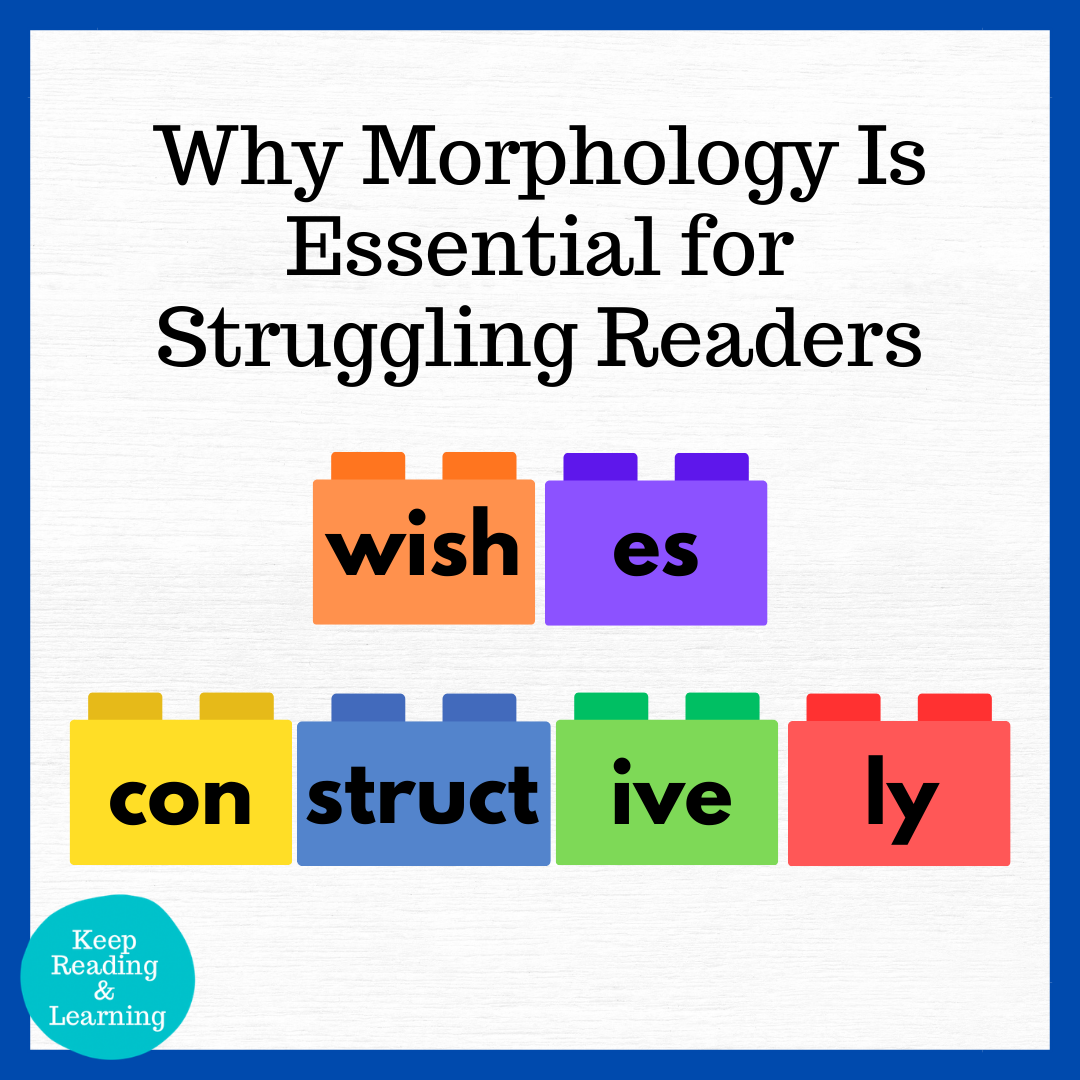
According to the International Dyslexia Association, morphological awareness is a skill that helps students problem-solve words they do not know how to read and spell. Picture a child looking at the word constructively. This is a long word, and it might be intimidating! However, students who have been studying the individual word elements will fare better as they attempt to decode the word and determine what it means in the context of the sentence:
- con-: a prefix that means together
- -struct-: a root that means to build
- –ive: a suffix that turns the base word (construct) into an adjective
- –ly: a suffix that turns the word into an adverb
Put together, constructively suggests that something is being done in a way that is useful, or helps to “build” something, whether literally or figuratively. If the student reads that “Bill worked constructively for one hour,” they can infer that Bill got some good work done in that hour.
I have seen firsthand how knowledge of prefixes, suffixes, and bases helps my students read and spell more confidently. When they have been reading, spelling, and playing games with word elements like con-, in-, -stant-, –sist-, –ed, and –ing, they become proficient at reading and spelling words like insisting, consisted, instant, and constant.
Conversely, I have seen how lack of morphological awareness can impede the recognition of multisyllabic words. A student I was evaluating did not recognize the prefix and base word in preshrunk. Consequently, they divided the word between the consonants and pronounced it as presh-runk. Unfortunately, this was not a teachable moment because it happened while I was administering the WIAT-IV. Had it been a teachable moment, we could have discussed the meaning of the prefix pre- and how it changes the meaning of the base word, shrunk. In my Wilson lessons, these are conversations we have regularly!
2. Morphology Strengthens Spelling and Orthographic Mapping

English is a morphophonemic language, which means that spelling patterns represent meaning as well as sound. And what does this mean for students who are learning to read and spell? It means that only learning letter/sound patterns (phonics) will offer an incomplete set of skills for spelling.
Are you wondering how and when to begin adding morphology to your lessons? It might be earlier than you think. After students understand letter/sound correspondence and basic spelling patterns, we can introduce morphology. A perfect first introduction to morphology comes after students are proficient with CVC words. At this point, they can learn the suffixes -s and -es, and read and spell words like bugs and wishes. Here are some key tenets your earliest readers and writers can learn:
- Suffix -s may sound like /s/ or /z/.
- Suffix -es sounds like /iz/.
- These suffixes can indicate a plural (e.g. cats) or be related to action (e.g. I run, he runs).
What I love about introducing -s and -es early is the moment students realize that spelling isn’t arbitrary. It’s a system with logic behind it. I’ve had young students light up when they understand why we add –s to digs even though it sounds like /z/. Something shifts when they grasp that the spelling is doing a job, signaling meaning and function, not just representing sounds. That sense of discovery is powerful, and it builds the kind of confidence that keeps struggling readers engaged and motivated to dig deeper into how words work.
3. Morphology Improves Vocabulary and Comprehension
When students learn to recognize shared word elements, they build vocabulary and comprehension simultaneously, often without even realizing it. I recently saw this in action during a lesson that included the prefix pre-. My student wasn’t sure what it meant, but he knew that a pregame party happens before the Super Bowl. That one connection unlocked a conversation about predict, preheat, and preschool. Once he had the concept, the meaning of unfamiliar words with pre– became much more accessible.
The good news is that students don’t need to consciously memorize every word element to benefit from this instruction. Explicit, repeated exposure to prefixes, bases, and suffixes builds an internalized sense of how words work, and that translates directly into stronger comprehension of the complex academic texts that so many struggling readers find daunting.
4. Morphology Instruction Is Backed by Trusted Structured Literacy Programs
Well-respected structured literacy programs include morphology because it is shown to improve outcomes. Some programs that incorporate morphology instruction include the Wilson Reading System, Barton Reading and Spelling System, Take Flight, and the Sonday System. Even if you’re not following a boxed or scripted program, take a cue from these reputable programs and incorporate morphology into your instruction, as well.
I’m most familiar with the Wilson Reading System, so I will walk you through how morphology is approached in the fourth edition of WRS. Per the manual, students are introduced to word elements through step-by-step, sequential instruction. The intent is to gradually build students’ strong understanding of the written system of English without overwhelming them (Wilson, 2018).
Here’s what that incremental learning looks like in the early Steps:
- Once students become proficient at reading and spelling CVC words, they dip their toes into morphology by learning about the suffixes -s and -es.
- As students become proficient in reading and spelling closed syllable words with blends, they are introduced to closed syllable Latin bases, like -ject- and -fess-.
- Once students gain basic skills in reading and spelling words with two closed syllables, they begin to use the Latin bases to work with words like construct and impress.
Additionally, students learn to investigate words in two different ways, which both support reading and spelling accuracy. Knowing both strategies is helpful because depending on the word, you may need one or the other.
- First, students may approach a word by considering the syllables and sounds. This would be a useful strategy for spelling a word like napkin, which is simply two closed syllables that don’t represent meaning independently of each other.
- On the other hand, it might be more helpful to approach a word by identifying the word elements instead. This is a more useful strategy for a word like misspell. Students who do not recognize the prefix mis- and the base word spell may attempt to spell it as mispell or mispel. These incorrect variations consider the sounds within the syllables, but not the meanings that they represent.

5. Morphology Benefits Struggling Readers and Students with Dyslexia
Instruction in morphological awareness and word elements is particularly important for students with dyslexia, as well as adults with low literacy skills (Wilson, 2018). These learners often require more explicit instruction and repeated exposure to patterns in the English language, and morphology delivers exactly that. Rather than asking students to memorize whole words, morphology gives them a system. When students recognize word elements within multisyllabic words (like prefixes and suffixes), they can break them into meaningful parts for improved reading and spelling.
When students in reading intervention classes understand prefixes, bases, and suffixes, they gain tools for decoding unfamiliar words, spelling more accurately, and understanding complex vocabulary. This reduces cognitive load and increases confidence, two things that matter enormously for students who have experienced repeated reading struggles.

I see this payoff regularly in my Wilson lessons. In Step 2, students practice reading and spelling Latin bases like –sist– and –stant– in isolation, building familiarity with their sounds, spellings, and meanings before encountering them in longer words. By the time they reach Step 3, where those same bases appear in two-syllable words like consist and instant, students often recognize them right away. That recognition is a game-changer! Instead of approaching a long word with anxiety, they approach it with a strategy.
Final Thoughts: Why Morphology Instruction for Struggling Readers Cannot Be Overlooked
Morphology instruction is not an optional add-on to phonics, but a necessary component of structured literacy, especially for students who continue to struggle with multisyllabic words, spelling, and vocabulary.
When we explicitly teach prefixes, bases, and suffixes, we give students tools to unlock meaning inside complex words rather than relying on memorization. For struggling readers, morphology can be the bridge between foundational decoding skills and true reading independence, strengthening word reading, spelling, and comprehension all at once.
Morphology Activities to Bring to Your Structured Literacy Instruction
If you’re ready to incorporate morphology activities into your lessons, start small. Introduce high-frequency suffixes like -s, -es, -ed, and –ing. Practice identifying prefixes in familiar words. Explicit instruction does not need to be complicated. It just needs to be consistent and intentional!
If you’re looking for ready-to-use morphology practice aligned with structured literacy routines, I’ve created activities that support my instruction. I use the activities below frequently, and I think you’ll love them, too!
Suitable for Various Structured Literacy Classrooms

- Suffixes -s and -es: Worksheets and Google Slides
- Word Crunch Phonics Game: CVC Words with Suffixes -s and -es
- Three Sounds of Suffix -ed: Bundle of Activities
- Decodable Passages with Suffix -ed: Includes all three sounds of -ed
- Reading Multisyllabic Words with Suffix -ed: Digital or Print
- Latin Bases: Closed Syllable Bases or Silent e Bases
- Common Closed Syllable Prefixes: Read and Spell Multisyllabic Words
- Reading Multisyllabic Words with Common Suffixes: Digital or Print
Wilson-Aligned Supplements for Homework and Extra Practice:

- Substep 1.6 Bundle: Suffix -s and -es Supplements
- Latin Base Supplements for Steps 2 and 3: Closed Syllable Bases
- Latin Base Supplements for Step 4: Silent e Bases
- Closed Syllable Prefix Supplements for Steps 3 & 4
- Substep 3.5 Bundle: Suffix -ed and -ing Supplements
- Substep 4.4 Bundle: Suffix -ive Supplements
- Substep 6.1 Bundle: Common Suffixes
- Substep 6.2 Bundle: Suffix ed Supplements
- Substep 6.3 Bundle: Words with Two Suffixes
Reference: Additional Key Terms Related to Morphology Instruction
- Free Morphemes: morphemes that can stand alone as independent words, such as cat or help.
- Bound Morphemes: morphemes that cannot stand alone and must be attached to another word element, such as un-, –ed, or –struct.
- Prefix: a letter or group of letters, which is added to the beginning of a word in order to form a different word. Some common prefixes are un- and re-.
- Suffix: a letter or group of letters, which is added to the end of a word in order to form a different word. Some common suffixes are -es, -ing, and –ment.
- Affix: a letter or group of letters, which is added to either the beginning or the end of a word to form a different word with a different meaning. Prefixes and suffixes are considered affixes.
- Base word: a word that can be used on its own or to create more complex words with the addition of affixes.
- Root words: hold the most basic meaning of a word but are often not stand-alone English words.
Want to receive blogs like this in your inbox twice per month? Join the email list below!
This post is an independent product and is not affiliated with, nor has it been authorized, sponsored, or otherwise approved by Wilson Language Training Corporation. WILSON®, Wilson Reading System®, Fundations®, Just Words®, and Wilson Fluency® are trademarks and/or registered trademarks of the Wilson Language Training Corporation.

