

Are you new to the science of reading research and looking for ways to help your students learn sight words without using memorization? Whether your students are in kindergarten, first grade, or second grade (or maybe they are older students reading at this early level), read on to learn how you can align your sight word instruction with the science of reading research. Help your students orthographically map high frequency words instead of memorizing them by sight! How? With word families!
What are word families?
One way to support students in orthographically mapping words to long-term memory is by working with word families.
A syllable can be segmented into onset and rime. In a single syllable, the onset is the consonant sound(s) before the vowel, and the rime unit is the remainder of the sounds beginning with the vowel.
Examples: c•at, bl•ock
The rime unit can also be called the word family. In the examples above, –at and –ock are the word families. Cat, bat, mat, sat, and flat are all in a word family because they have the same rime unit of –at. A helpful way to remember it: the rime unit is the part that you rhyme with!
Why should students work with word families?
Research shows that working with high frequency word families can be a powerful strategy for early readers. If we look at the 37 most common word families, almost 500 words can be made from them! This means that becoming familiar with common word families will help unlock hundreds of words within those word families.

Can we use word families to help our students learn “sight words”?
Yes, we can use word families to help our students orthographically map all kinds of words. But before we dive in, let’s clarify some key terms. “Sight word” is an often misunderstood term, so we want to be clear about what types of words we are talking about when we discuss using word families to support the orthographic mapping process.

In this post, we’re talking about helping phonetically regular high frequency words from the most common word families become sight words.
The phonetically regular high frequency words are words that appear on lists like the Dolch and the Fry list, but they follow expected spelling rules for our language. They’re words like black, day, make, and thing. Just because they are included on a “sight word” list doesn’t mean there’s anything tricky about them! We can take the mystery out of these words by studying their letter/sound connections.
Still feeling confused about why some of the Dolch and Fry high frequency words don’t need to be memorized by sight?
Let’s look at a few phonetically regular words from the Dolch and Fry lists:
- Black: This is a closed syllable word with a short vowel sound. It begins with a consonant blend and ends with a consonant digraph. Students who know short vowels, consonant blends, and consonant digraphs should read and spell it with ease.
- Day: This is a vowel team syllable. The vowel team ay consistently represents the long a sound. Students who have learned vowel digraphs should easily learn to read and spell this word.
- Like: This is a silent e syllable. Students can learn to read and spell it when they complete a unit on silent e.
- Each: This is a vowel team syllable that ends with a consonant digraph. Students can learn to read and spell it when they learn vowel digraphs for the long e sound.
Back to the question: Can we use these word families to help our students learn high frequency words? We can and we should!
Teaching high-frequency words by rime unit or word family has several benefits:
- It allows students to orthographically map the sounds for permanent storage rather than memorizing words by sight as a whole. The strategy of memorizing words by sight through visual memory is not supported by research.
- It allows you to teach several similar high-frequency words at the same time, which increases the likelihood of the words entering your students’ long-term memory. For example, –ell is one of the most common word families and it appears in the Dolch and Fry words bell, fell, sell, smell, spell, tell, and well.
- You can align your “sight word” instruction with your phonics instruction. For example, when you are working in the main rule of silent e, you can teach the high frequency words from the Dolch and Fry lists that include the common silent e word families -ake, -ame, -ate, ide, and –ine.

How I incorporate the high frequency word family worksheets in my instruction
When I learned these benefits, I was a teacher who had a passion for learning about the science of reading, but I didn’t have a program or formal training yet. I looked for ways to incorporate the common word families in my reading and spelling instruction. Then I decided to focus on the Fry words that use these word families. When I taught the regularly-spelled Fry words this way, it felt less daunting to help my students learn all those high frequency words because they were already being addressed in my regular lessons.
Side note: I make sure my students understand high-frequency words as “very useful words for reading and spelling” and “words that you will need to read and spell very often,” so they know the importance of practicing them. We built them, wrote them, and read them throughout the unit to increase their fluency and eventually add these words to their “sight word bank” of automatically recognized words.
Meet Your New Best Friend: High Frequency Words Sorted by Word Family
Next, I made myself a chart of the Dolch and Fry words organized by word family. Each time I introduced a new phonics rule, I checked my chart and decided which word families would be most useful to my students. For example, when I introduced the digraph –ck, I printed the pages for –ack, -ick, -ock, and –uck and incorporated them into my lessons for the unit.

Currently, I’m working with UFLI and Wilson as my main programs. Instead of using the word family worksheets as part of my main instruction, I send them home for homework and extra practice between tutoring sessions.
A word of caution when working with word families:
Make sure you don’t fall into the habit of encouraging students to memorize word families without making connections to the individual letter/sound correspondences.
According to Kilpatrick (2016), “efficient permanent storage of rime units comes when a student can map each element in a rime (e.g. i-p = ip).” When I teach with word families, we still pay attention to the individual letters in each rime unit.
How do we make sure students are not memorizing the word families by sight?
With the direct mapping technique! Direct mapping is a technique used to help students make connections between the individual sounds within words and the corresponding letters (Kilpatrick, 2016). The teacher asks questions that will help students develop essential skills for successful word recognition. Through the direct mapping process, students will:
- Practice segmenting and isolating phonemes
- Develop the habit of studying the entire word instead of looking at the first letter and making a guess
- Learn to rely on the regular letter-sound connections to decode, which takes the mystery out of many high frequency words, particularly ones with irregular elements
- Be encouraged to orthographically map letter strings. The letter strings might include portions of a word (such as rime units) or the whole word.
Once words have been mapped, they are in long-term memory for automatic retrieval. That’s a fancy way of saying words become sight words!
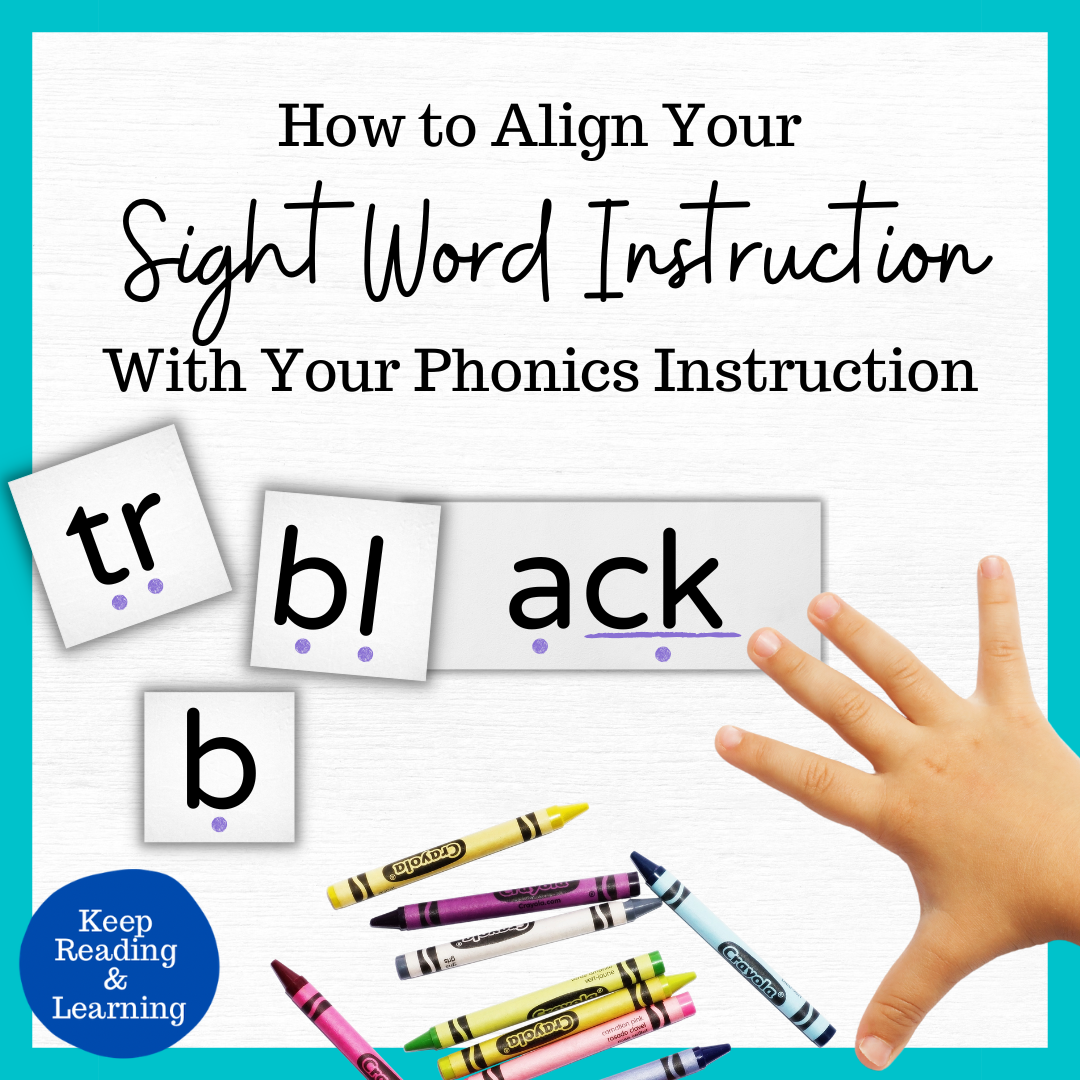
In the worksheets I use, there are dots included under each sound in a word family. I encourage my students to touch the dots as they decode, which further emphasizes the letter/sound connections. In addition to ensuring that they’re not memorizing the word family by sight, it also promotes orthographic mapping of the word family.
So, are you ready to align your phonics instruction with your high frequency word instruction?

These worksheets will help you teach your students to read and spell words from the Dolch and Fry lists using research-backed methods that promote orthographic mapping. There are three student options included, so you can differentiate and add variety to your lessons:
- Version 1: The cut & build option you see above is the most popular version with early elementary teachers. You’ll guide students to build words with letter tiles they’ve cut from the bottom of the sheet.
- Version 2: Offers onsets (letters to add to the beginning of the word family) to help your students write and read words.
- Version 3: This worksheet offers blank spaces for students to write words within the word family. You can follow their lead or guide them to write specific words from the provided word list.

Top left: Students write letters from the box at the top of the page to create words in the word family. There is also space to add additional words that your students brainstorm. Middle right: The teacher guides the students in writing words in the word family. This page can also be used as a recording sheet for the cut & build version, shown in the center.
Need a list of high frequency words organized by phonics skill?
The Teacher Reference Chart lists the Dolch and Fry words by word family, and it will be your new best friend! Your download also includes simple, clear directions for using the direct mapping technique with each worksheet. It has everything you need to confidently begin teaching the regularly-spelled high frequency words by word family!
⭐ Teacher Reviews for the Word Family Resources
Curious how this resource works in real classrooms? Here’s what teachers who have used it to align their sight word and phonics instruction had to say:
“I am in LETRS training and this resource helped me implement strategies I was taught to use with my students.” -Deborah B.
“I appreciate the explicit nature of this resource, knowing it takes intentional instruction to help students map words to be part of their sight word bank. Great resource!” -Sarah K.
“This is a fantastic resource! I use it at my teacher table during word work. The students enjoy building words with this resource.” -Sharon M.
“This is a very amazing resource that is so very helpful & also very detailed in the research & how it helps your kids.” -Kayla T.
“Love that students can see the connections they are making while using this product.” -Kirsten F.
If you’re ready to make your high frequency word instruction more meaningful, research-based, and easier to plan, you can find the High Frequency Word Family Worksheets in my store. They’re a simple way to help students connect phonics and high-frequency words while promoting orthographic mapping.
Wondering how to teach high frequency words with irregular spellings or untaught phonics rules?
What about words that don’t “follow the rules,” like said, of, and could? These words with irregular spellings require different strategies! Check out my blog post, Teaching “Sight Words” the Science of Reading Way or download all of my favorite spelling tricks for high frequency words.
Want to receive blog posts like this delivered to your inbox twice per month? Sign up below!
Source: Kilpatrick, David A. Equipped for Reading Success: A Comprehensive, Step-By-Step Program for Developing Phoneme Awareness and Fluent Word Recognition. Syracuse, NY, Casey & Kirsch Publishers, 2016. (Affiliate link)

