
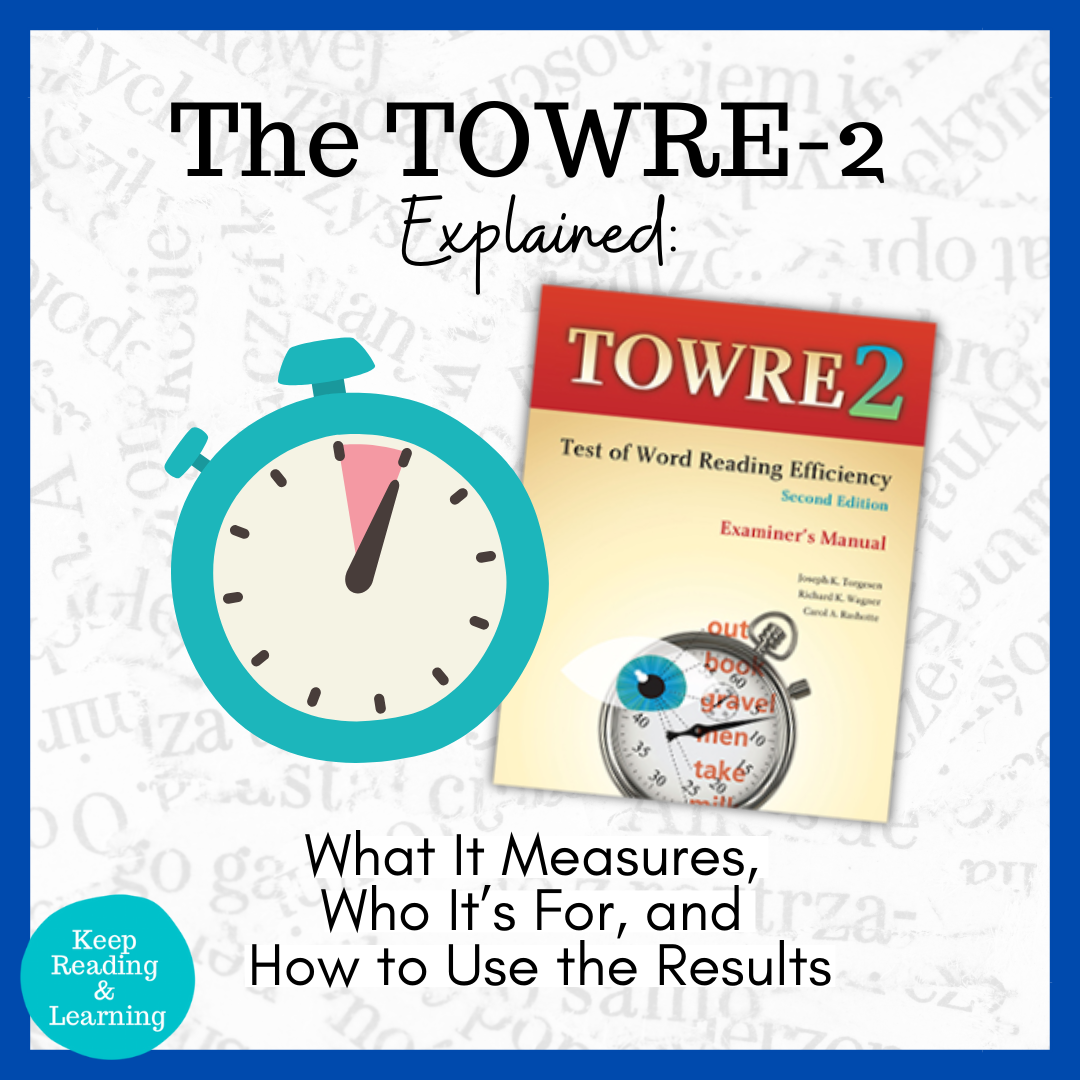

This post answers a common question educators ask: What is the TOWRE-2, what does it measure, and why might you choose to use it? I’ll also explain how to interpret TOWRE-2 scores and how this assessment complements broader academic achievement measures when making instructional or eligibility decisions. This post is an answer to your requests on Instagram for more blog content about literacy assessments like the CTOPP-2 and the WIST!
Who is this blog post for?
- Special education teachers, reading interventionists, and private reading tutors: Learn how and why you can use the assessment in your evaluations or for progress monitoring.
- Classroom teachers and administrators: Learn the purpose of the assessment and gain insight that will help you understand evaluation reports that include TOWRE-2 results.
- Parents: If you are concerned about your child’s reading progress, you’ll feel confident advocating for the use of this reliable progress monitoring assessment.
What is the TOWRE-2, and what is it used for?
The Test of Word Reading Efficiency–Second Edition (TOWRE-2) is a commonly used, brief standardized measure of word reading efficiency. It provides information about a student’s ability to accurately and automatically read both real words and nonwords, making it a useful tool within a comprehensive reading evaluation.
The TOWRE-2 measures decontextualized reading skills. This means that students must rely on their word recognition and decoding strategies, rather than using context clues within the surrounding words to make a successful guess.

Why is it important to assess decontextualized reading skills?
It’s common for students with strong oral language skills to compensate for decoding weaknesses by using context clues to guess at words. With the TOWRE-2, the words are presented in a list, so it offers a more accurate representation of the child’s word recognition and decoding skills.
The manual notes that there are three main reasons that people choose the TOWRE-2:
- Early Identification of elementary-aged students who require more explicit instruction in order to make progress.
- Diagnosis of Reading Disabilities: The TOWRE-2 is an excellent addition to the battery of tests commonly used to identify reading disabilities.
- Research: Researchers often use the test to track progress in their studies.
What age range is the TOWRE-2 for?
The TOWRE-2 is normed for individuals ages 6 through 24, though it is sometimes used with adults for descriptive purposes.
What are the subtests?
The TOWRE-2 includes two subtests: Sight Word Efficiency (SWE) and Phonemic Decoding Efficiency (PDE). SWE requires students to read aloud from a list of real words within a 45-second time limit. PDE requires students to decode a list of nonwords within a 45-second time limit.
Using the TOWRE-2 for Progress Monitoring
The TOWRE-2 can quickly and easily be implemented in school settings to help identify students who are not making adequate progress and may require additional/different interventions. It includes four different forms that can be implemented throughout the year. Data is an integral part of any successful Response to Intervention (RTI) framework, and the TOWRE-2 makes data collection quick and relatively simple.
The TOWRE-2 is considered a “general outcome progress monitoring assessment,” according to the publishers. This means that it likely will not tell you which skills a student has mastered and which skills they need further instruction in, but it will tell you if their current instruction is resulting in progress.
You can compare raw scores from one assessment data point to the next to determine if the student’s performance has improved. You can also compare scaled scores from one data point to the next to determine how the student’s performance changed in comparison to their same-age peers.
Sample Scenario: Given the Sight Word Efficiency subtest, Evan correctly read 24 words in September and 34 words in December. His raw score improved from 24 to 34, which is evidence of progress: he read more words accurately within the 45-second time limit! Let’s also consider how his performance compares to his peers: because Evan is eight years old, his scaled score increased from 73 in September to 82 in December, which means that his performance shifted from the Poor range to the Below Average range. This means that Evan absolutely demonstrated growth given his current instruction, but he continues to require support to meet age-based expectations.

I chose to invest in the TOWRE-2 so I could use the progress monitoring forms. As a private tutor, I plan to use the TOWRE-2 as a way to communicate progress to families throughout the year. I use the WIST for baseline data and can repeat it on a yearly basis, but the TOWRE-2’s progress monitoring forms can provide us with data on a more regular basis. It’s also a much quicker assessment, which is a bonus for both my students and me!
What does it mean if a student does poorly on the TOWRE-2?
In the simplest terms, poor performance on the TOWRE-2 suggests that the child requires intervention. According to the manual, “Any score on the TOWRE-2 below the 25th percentile, based on current norms, warrants special interventions to improve word-level reading skills.”
A student who does poorly on both subtests likely needs remediation in literacy skills. If the TOWRE-2 was used as part of a full evaluation, the team should consider the results of the TOWRE-2 alongside the results of achievement testing and cognitive testing, as well as any informal data available. The team may also wish to complete a diagnostic test, such as the WIST, to determine which skills the student has mastered and which skills the student needs to learn. The results of a test like the WIST will help the team create goals and plan instruction.
If a student does well on the Sight Word Efficiency subtest but poorly on the Phonemic Decoding Efficiency, this may indicate that :
- The student has memorized many real words by sight, but needs to learn more strategies for identifying unfamiliar words.
- The student has strong orthographic recognition skills (the ability to recognize letter strings to read words automatically) but a weakness in phonetic decoding skills.
- The student is unfamiliar with the task of decoding nonwords.
The last factor is one that can negatively impact a student’s score. Some instructional approaches do not include the practice of reading and spelling nonwords. If a student has never attempted to read nonwords before, even simple ones, they may feel confused or overwhelmed by the task. Be sure to follow the directions in the manual for administering the practice words. This will ensure that your student understands the expectations of the task, which makes their score a more accurate representation of their ability.
Why should I give the TOWRE-2 in addition to an academic achievement test like the WIAT, WJ, or KTEA?
Unlike some broad achievement tests, the TOWRE-2 captures efficiency under time constraints, which is often missed in untimed measures. This can be especially helpful when a student demonstrates adequate accuracy on achievement testing but struggles with automaticity and reading fluency.
For me, the greatest appeal is the progress monitoring option. With a very small investment of time, we can access valuable data about how a child is progressing and how their performance compares to their same-aged peers. Achievement tests are not designed to be repeated frequently, but the TOWRE-2 allows teams to monitor change over time without the burden of lengthy reassessment.

Is the TOWRE-2 a valid and reliable measure of student achievement?
Yes. It was normed on 1,717 individuals ranging in age from 6 to 24 years. The publisher notes that the individuals were carefully selected to represent the demographic characteristics of the U.S. population. This means that the TOWRE-2 was designed to provide accurate and consistent results across diverse populations. Its standardization ensures that the test measures what it claims to measure, while accounting for variations in age, geography, and educational backgrounds.
Who can purchase and administer the TOWRE-2?
According to the publisher, the TOWRE-2 may be purchased by individuals with Qualification Level B. Level B requires “a master’s degree in psychology, education, occupational therapy, social work, counseling, or in a field closely related to the intended use of the assessment, and formal training in the ethical administration, scoring, and interpretation of clinical assessments.” This likely describes most special education teachers!
Additionally, the manual notes that “the test can be administered by anyone who can read and understand the test manual and has knowledge of standard assessment procedures.” It is noted that this may include teachers, instructional aides, school psychologists, speech pathologists, and school counselors.
How long does it take to administer the TOWRE-2?
It takes less than five minutes! This is one reason that the TOWRE-2 is great for progress monitoring. You gain a valuable data point in a short amount of time.
What scores will I get?
The TOWRE-2 provides age equivalents, grade equivalents, percentile ranks, subtest scaled scores, and a Total Word Reading Efficiency Index.
Norms for the TOWRE-2 subtests have a mean of 100 and a standard deviation of 15. Children whose scores fall within the Average range have a scaled score of 90-110.
How do you administer the TOWRE-2?
Administration is relatively simple, but be sure to read the directions in the manual and consider practicing with a friend or family member before you administer the test to a student. A few key points:
- You need a reliable timer or stopwatch.
- You must administer all portions of the test individually.
- Ensure that you are in a quiet space so that you can hear the student clearly.
- Some words have more than one correct pronunciation. Familiarize yourself with the options before you administer the test.
How do you score the TOWRE-2?
Raw scores are converted using the tables in the manual. For each subtest, the raw score is the number of words or nonwords read correctly within the time limit.
Are there any downsides to this test?
It is important to note that the TOWRE-2 is not a comprehensive assessment of reading skills. This is not necessarily a downside if you recognize it from the beginning. Depending upon the purpose of your evaluation, you may need to administer other assessments in addition to the TOWRE-2.
How can I purchase the TOWRE-2?
You can purchase the complete TOWRE-2 from PRO-ED or other assessment companies, typically for around $385. (This price is accurate at the time of publishing.) I also invested in the Response to Intervention booklets, which will support me in tracking progress in my private tutoring clients. Each booklet is essentially the examiner’s record book for all four forms (A, B, C, and D) in one place. The cover page allows me to easily view the scores each child received throughout the course of the year.
You can also check marketplaces like eBay or Facebook groups for reading tutors. Some people have luck borrowing the testing kit from local teachers, trainers, or colleges. Make sure you get the second edition so you are using the updated norms!
Would you like to learn about other assessments for reading interventionists?
Bookmark these past blogs:
- The CTOPP-2: A Guide for Parents and Teachers
- CTOPP-2 Score Interpretation: How to Write Clearer Reports
- Understanding the WIST: A Resource for All Literacy Teachers

