
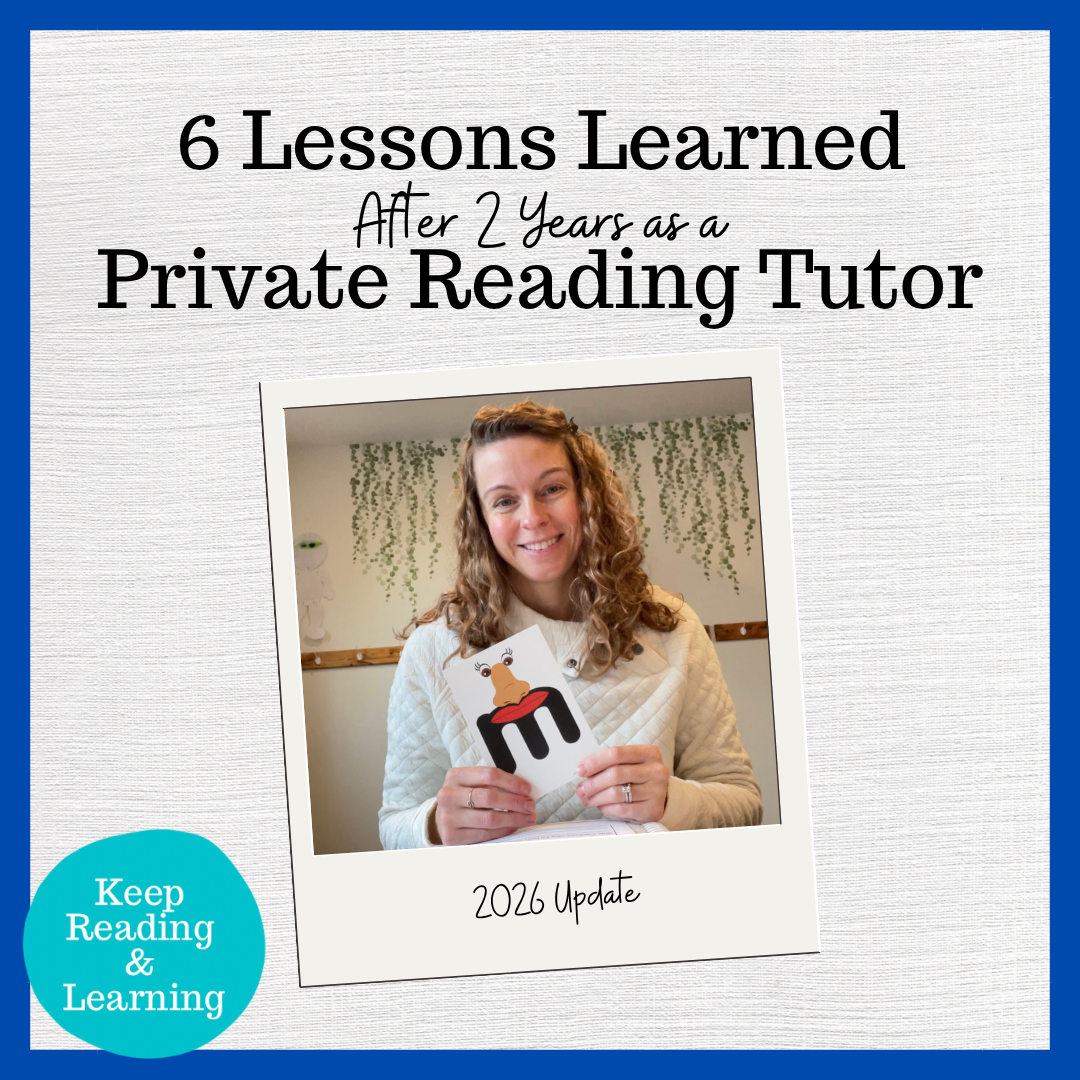

This summer marks the two-year anniversary since I chose to leave public schools and began running a private tutoring business. After almost two decades in public school special education, I was burnt out, uninspired, and generally feeling stuck. A few factors gave me the security I needed to make a leap: my own children were becoming more independent, my TPT income offered me a safety net, and my husband was willing to take on extra financial responsibility as I established myself.
Perhaps the most important factor was that I felt renewed with enthusiasm for my field. My burnout needed to go through phases before I was ready to leave. I spent some time feeling defeated and exhausted. I did some research about what it would take to make a career change. I found an idea that sparked a flame inside, and I began taking steps toward my new goal. Instead of being overwhelmed by the prospect of running a private tutoring business, I became excited.
I’m now an established homeschool reading interventionist in my region. I work with students with reading and spelling challenges ranging from kindergarten through eighth grade. I consult with homeschool parents to help them improve their literacy instruction, and I consult with public school parents to help them advocate for their children.
Do I miss anything about public school? If I’m being honest, mostly the photocopier. And maybe the comfort of knowing a paycheck was coming regardless of how well I was doing my job, but that’s exactly the kind of complacency I wanted to leave behind. For now, things are working, and I have no major regrets.
Read on to see what two years of running a private tutoring business has taught me.
This post may contain affiliate links.
1. Continue Adapting & Looking for New Opportunities
Although I had a plan before leaving the classroom, I couldn’t have predicted how running a private tutoring business would evolve. I imagined working with upper elementary students who were struggling with basic literacy skills, since that’s what I’ve done for most of my career. I didn’t know I’d end up:
- Teaching small groups of K-2 children at a nearby nature-based school
- Completing yearly homeschool progress evaluations
- Completing literacy evaluations to help parents adjust their curriculum
- Acting as an advocate for public school families
- Becoming a consultant for parents who want to continue being the main provider of their child’s literacy instruction

Many of these opportunities unfolded as I met parents and other providers in my area. Some opportunities fell in my lap, while others were the result of my seeing a need within my community and finding a way to offer it to people. If you want your full-time business to thrive, you’ll need to keep evolving: meet the needs of the people you meet, but do it in a way that still makes your heart sing.
And remember that evolving doesn’t have to mean settling. You can still say no to opportunities, because that’s a perk of being your own boss. I choose not to teach math now. Could I earn more income by including math in my services? Of course. But does teaching math make my heart happy? Nope. So I’ll put my energy into other opportunities instead. Evolve intentionally, and your business will reflect the work you actually want to be doing.
2. Have a Contract and Follow It
Teachers are naturally caretakers, and that can make it challenging for us to think like business owners. I like to give people the benefit of the doubt, and I really dislike conflict. This makes me instinctively want to be less firm about contractual issues. However, when you’re running a private tutoring business, you need to set boundaries and not be influenced by your own caretaker instincts. Having a contract (and following it!) helps you set the boundaries that will protect both your financial and your mental well-being.
It’s easy to let things slide when you’re just starting out and grateful for every client. But when you have ten families, and the Smith family has made late payments several times without ever being charged the late fee (because you never enforced it from the start), it becomes a much harder conversation to have. If I could go back, I’d follow my contract consistently from day one, with every client.

It can feel mean, but it isn’t. Doctors, contractors, and personal trainers all enforce their policies (late fees, cancellation charges, no-show fees), and no one thinks twice about it. You’re a professional, too, and your contract reflects that.
Not sure what to include in a contract? Keep Reading and Learning’s Editable Reading Tutor Contract Template is perfect for structured literacy tutors. It’s easy to download and adapt to your needs, making it the ideal solution for drafting your tutoring contract effortlessly.
3. Remember Why You Left
In a world that glorifies hustle and busy-ness, choosing to slow down is a radical act. When you become your own boss, you’re not just changing jobs. You’re giving yourself permission to live differently. Don’t forget that.
If you’re reading this blog, you’re likely experiencing burnout in the classroom, or you did in the past. What pushed you there? Lack of planning time? Unmanageable group sizes? No access to fresh air or natural light? Working through your lunch block? Missing too many moments with your own kids? Unrealistic paperwork expectations? Those circumstances felt out of your control then, but you have control now.

Use it. Give yourself a real lunch break. Eat outside. Take a walk between clients. Chaperone that field trip. Switch to virtual sessions on a day when you need the flexibility. Say no to clients who feel like a drain. Say no to anything that chips away at the balance you worked so hard to build.
You didn’t take this leap so you could work for a meaner, more demanding boss, so don’t become one.
4. Get Comfortable Being Observed
If you’re an introvert or someone who gets nervous during formal classroom observations, here’s something that might surprise you: you will probably be watched more as a private tutor than you ever were in a classroom.
Most professional liability insurance policies recommend that a parent remain within earshot during sessions, and in practice, that often means they’re right there in the room with you. At some point this year, it occurred to me how funny it was that formal school observations used to stress me out, yet now I’m being watched several times a week without giving it a second thought!

The difference is context. Parents aren’t there to evaluate you. They’re either picking up strategies they can use at home, or they’re sitting nearby, completely absorbed in their own laptop. Once you internalize that, being seen stops feeling like scrutiny and starts feeling like just another part of the session.
If you’re nervous about this as a new tutor, give yourself some grace. It gets easier quickly. And honestly, having parents close by becomes one of the more rewarding parts of the job. When they see firsthand what you’re doing and why, it builds exactly the kind of trust that keeps families coming back.
Didn’t know that you need professional liability insurance? Bookmark this page: Crucial Questions to Ask Before Establishing Your Tutoring Business
5. Make Systems for the Tasks You Dread
I know I encouraged you to say no to things that drain you, but running a business means some unavoidable tasks come with the territory: sending invoices, tracking expenses, advertising when you need new clients. You can’t skip them, but you can make them easier.
My pattern tends to be: avoid the task, let it pile up, finally decide I need a system, build the system, and then wonder why I waited so long. For me, one of those tasks was tracking printed materials for different students. Once I set up a simple spiral-bound folder system, it stopped being something I dreaded.
Think about what your version of that is. Maybe you keep forgetting to log purchases for tax deductions, or you lose track of which families have paid. Whatever it is, carve out some time to build a solution, physical or digital, before it becomes a recurring headache. The upfront investment is always worth it.

See the supplies that make my traveling days a breeze: The Ultimate Packing List for Traveling Reading Teachers
6. Schedule Time for Professional Development
In the early days of running a private tutoring business, I had the luxury of plenty of free time for trainings and webinars. Now that my schedule is consistently full, that free time has quietly disappeared. Before I knew it, I had a growing list of webinar recordings and Wilson Professional Learning modules that I kept meaning to get to.

The stakes feel higher when you hold multiple credentials. I maintain state licensure in two states, and I hold two professional certifications that require renewal: Wilson Dyslexia Practitioner and Certified Structured Literacy Dyslexia Interventionist. Fortunately, many professional development opportunities count toward all four, but there are always gaps. Massachusetts, for example, requires a specific number of credits related to multilingual learners. Keeping up with all of it takes intention.
My plan going forward is to dedicate time each month specifically to professional development, the same way I’d schedule a client session. If you hold certifications or licensure, I’d encourage you to do the same before renewal deadlines sneak up on you.
Final Thoughts After 2 Years of Running a Private Tutoring Business
Two years in, I can say that running a private tutoring business is everything I hoped it would be, and also harder than I expected in ways I didn’t anticipate. The freedom is real, but so is the responsibility. The flexibility is wonderful, but it requires discipline to protect. The work is meaningful, but it still requires systems, boundaries, and intention to sustain.
If you’re dreaming of making this leap, I hope this post offered a realistic and encouraging picture of what life can look like on the other side. It won’t look exactly like mine… Your opportunities, your community, and your individual strengths will shape something uniquely yours. But if you go in with a plan, stay open to how that plan evolves, and remember to be as kind to yourself as you are to your students, you’ll be in good shape.
I’m not sure what the next two years will bring, but I’m showing up curious, intentional, and grateful. And for now, that’s enough.
Are you considering leaving the classroom and transitioning to private tutoring? I’ve compiled all of my favorite tools, resources, and valuable information in one place:


